







Divi is one of the most powerful WordPress page builders available, but its flexibility comes at a performance cost. A default Divi install with no optimisation applied will score poorly on Google PageSpeed — typically in the 40–60 range on mobile — because of the CSS it generates, the JavaScript it loads, and the images most Divi sites use.
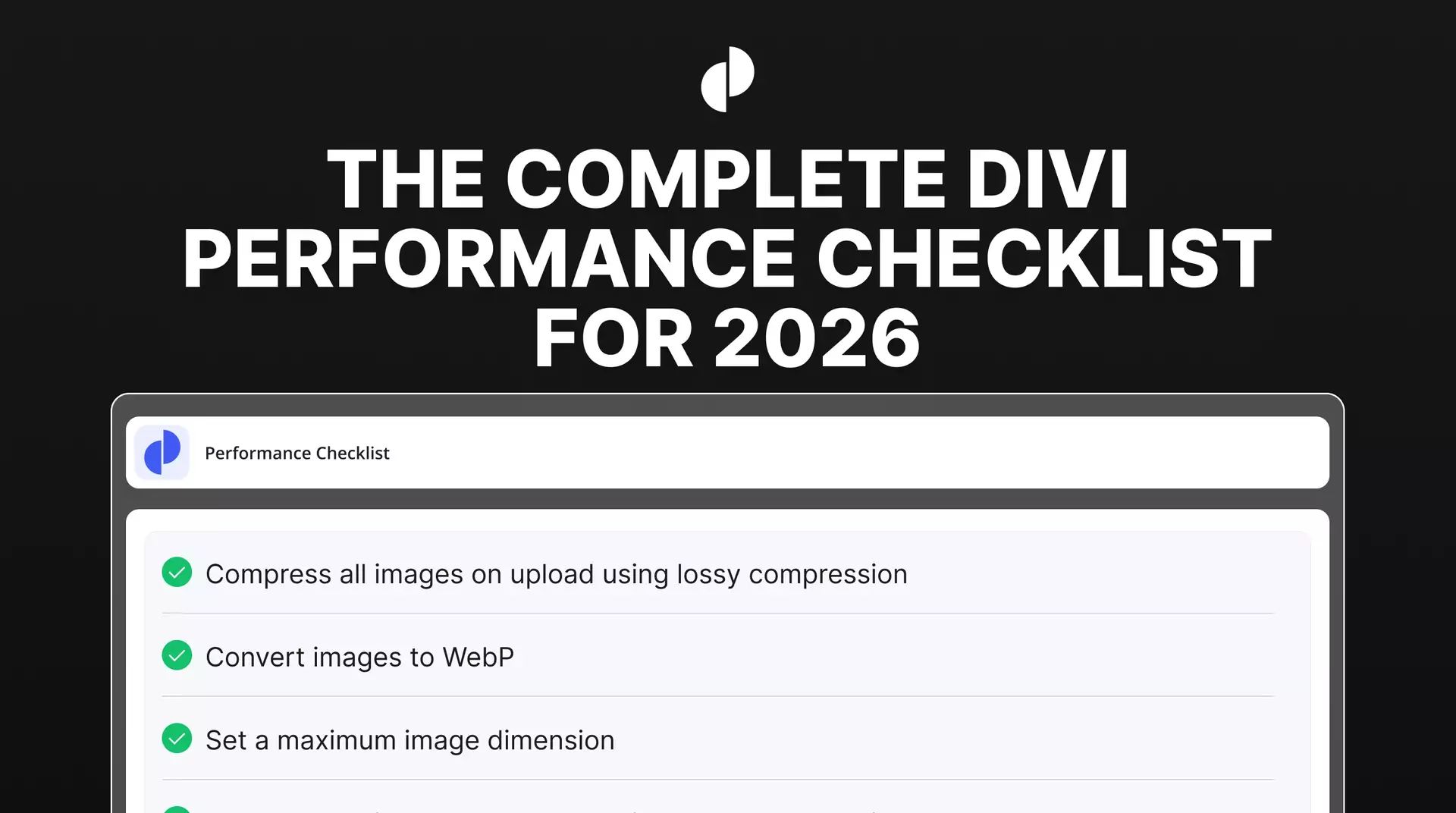
The good news is that every single one of these performance issues is fixable. This checklist covers every optimisation worth making on a Divi site in 2026, in order of impact. Work through it top to bottom and you should see your mobile PageSpeed score in the 80–95 range by the end.
Section 1: Images
Images are almost always the single highest-impact performance issue on a Divi site. They are the largest assets on the page, they directly affect Largest Contentful Paint, and they are entirely fixable with one plugin.
Compress all images on upload using lossy compression. Lossless compression saves 3–5% at best. Lossy compression (quality 75–85) saves 40–70% with no visible difference to the human eye. Install Divi Image Compressor and set your quality level once — every image uploaded from that point forward is compressed automatically.
Convert images to WebP. WebP files are 25–35% smaller than equivalent JPEGs. Enable WebP conversion in Divi Image Compressor. Every upload generates both the original and a WebP version. WordPress 5.8+ serves WebP natively.
Bulk compress your existing media library. New uploads get compressed automatically, but your existing library does not. Run the bulk compress tool in Divi Image Compressor to process all existing images in one operation.
Set a maximum image dimension. No Divi module displays images wider than 2000px. Set a max dimension of 2000px (or 1600px for most sites) so oversized originals are scaled down on upload.
Set explicit width and height on images. Missing width/height attributes cause layout shift (CLS). In Divi modules, check that your image modules have dimensions set.
Optimise your hero image specifically. The hero image is almost always the Largest Contentful Paint element. Compress it aggressively (quality 75–80, WebP), keep it under 200KB, and consider preloading it with a <link rel="preload"> tag in your header.
Section 2: Divi's Built-In Performance Options
Divi has a Performance tab under Theme Options that many users never explore. These settings have a significant impact and require no additional plugins.
Enable Static CSS File Generation. This combines all of Divi's dynamic CSS into a single static file rather than generating it in PHP on every request. Go to Divi → Theme Options → Performance and enable this option.
Enable Critical CSS. Extracts the above-the-fold styles and loads them inline, deferring the rest. Dramatically improves First Contentful Paint.
Enable Dynamic CSS. Only loads the CSS for modules actually used on each page, rather than the full Divi stylesheet.
Defer render-blocking JavaScript. Under Divi's Performance settings, enable deferred JavaScript loading where available.
Combine Google Fonts requests. Divi's default behaviour makes a separate HTTP request per font family. Enable font combining in Divi's Performance settings to merge them into a single request.
Section 3: Caching
Without caching, WordPress builds each page from scratch on every visit. Caching stores the finished HTML and serves it directly, eliminating the database queries and PHP execution time.
Install a caching plugin. WP Rocket is the most Divi-compatible paid option. WP Super Cache and LiteSpeed Cache are strong free alternatives. If you are on managed hosting (Kinsta, WP Engine, SiteGround), check whether your host provides server-level caching before adding a plugin — many do.
Enable page caching. Store complete HTML pages in cache so repeat visitors get instant responses.
Enable browser caching. Tell browsers to store static assets (CSS, JS, images) locally for a set period. Reduces repeat-visit load times dramatically.
Enable GZIP or Brotli compression. Compresses text-based assets (HTML, CSS, JS) for transfer. Most hosts enable this at the server level — check your hosting panel.
Enable database optimisation. WordPress databases accumulate post revisions, transients, and expired data over time. WP Rocket, WP-Optimize, and similar plugins can clean these up on a schedule.
Section 4: Fonts
Fonts are frequently overlooked as a performance issue. Every font family and weight is a separate HTTP request, and Google Fonts requires a DNS lookup to an external server.
Limit font families to two. Most Divi sites use more font families than they need. Audit your Typography settings across sections, rows, and modules. Two families maximum.
Limit font weights. Each weight variant is a separate file. Use one or two weights per family (e.g. 400 Regular + 700 Bold).
Self-host your Google Fonts. Eliminate the Google Fonts DNS lookup by downloading and serving fonts from your own server. Use the OMGF plugin to automate this. Saves 200–400ms on first visit.
Use system fonts for body text if design allows. System fonts (–apple-system, BlinkMacSystemFont, Segoe UI) require zero HTTP requests and load instantly. For a clean, modern Divi design, system fonts can work beautifully.
Section 5: JavaScript
JavaScript is the most common cause of high Total Blocking Time scores in Divi sites. Every plugin that adds JS to the front end contributes to the problem.
Audit your plugin list. Install Query Monitor and check which plugins are loading scripts on each page. Remove any plugin you are not actively using.
Defer or delay non-critical scripts. WP Rocket's "Delay JavaScript Execution" feature holds third-party scripts (chat widgets, analytics, advertising) until the user first interacts with the page.
Load third-party scripts only where needed. A contact form plugin does not need to load its JavaScript on every page — only on the page containing the form. Use WP Rocket, Asset CleanUp, or Perfmatters to exclude scripts from unnecessary pages.
Replace heavy plugins with lightweight alternatives. If you are using a slider plugin, a countdown timer, or an animated element plugin that loads a large JavaScript library, consider replacing it with a native Divi module or a lighter alternative.
Section 6: Hosting
No amount of front-end optimisation compensates for slow hosting. Your server response time (Time to First Byte) is the foundation everything else sits on.
Check your TTFB. Use GTmetrix or WebPageTest to measure your Time to First Byte. Under 200ms is good. Over 600ms is a hosting problem no plugin can fully fix.
Use a PHP 8.x version. PHP 8.1 and 8.2 are significantly faster than PHP 7.4. Check your hosting panel and update if you have not already.
Use hosting with an LPU in your target geography. If your clients are in the UK, your server should be in the UK or EU. Latency adds up on every asset request.
Use a CDN for static assets. A content delivery network caches your static files (CSS, JS, images) on servers around the world. Cloudflare's free plan is the easiest starting point.
Section 7: Core Web Vitals Specifically
Google's ranking algorithm uses three Core Web Vitals: LCP, CLS, and INP (Interaction to Next Paint, which replaced FID in 2024).
LCP under 2.5 seconds. Compress your hero image, preload it if needed, enable caching and CDN. LCP is almost always an image or font issue on Divi sites.
CLS under 0.1. Set explicit image dimensions, avoid injecting content above existing content, and be cautious with font-swap behaviour (use font-display: swap to prevent invisible text during font load).
INP under 200ms. Reduce JavaScript execution time, defer non-critical scripts, and avoid long-running event listeners. Divi's own JavaScript is generally well-optimised but third-party scripts are common offenders.
Quick Wins Summary
If you want to make the highest-impact changes first, do these five things in order:
- Compress images and enable WebP — Divi Image Compressor, 5 minutes to set up
- Enable Divi's Static CSS and Critical CSS — Divi → Theme Options → Performance
- Install a caching plugin — WP Rocket or your host's built-in caching
- Reduce Google Fonts — 2 families max, self-host with OMGF
These four changes alone will move most Divi sites from the 40–60 range to the 75–90 range on mobile PageSpeed. The rest of the checklist gets you from good to excellent.
Divi Image Compressor
Divi Image Compressor does one thing: compresses and converts every image on your Divi site, automatically, on your own server, without any setup beyond installing the plugin. For Divi 4 and Divi 5 sites, that is exactly what you need.
Divi Image Compressor is available as a one-time purchase on the Elegant Themes Divi Marketplace. There are no subscriptions, no API keys, and no limits on how many images you can compress.
Divi Image Compressor is developed by DiviPerfect — a suite of Divi 5 plugins built for freelancers, agencies, and businesses. Questions? Email us at hello@diviperfect.com or visit diviperfect.com.